- DataArts News
What Crisis Revealed: Culture, Investment, and the Work That Continues
- Posted Aug 17, 2026
“The world changes according to the way people see it, and if you can alter, even by a millimeter, the way people look at reality, then you can change the world.” — James Baldwin

In 2019, arts organizations in BIPOC-majority neighborhoods of a major U.S. city received 16% less median grant funding than those in white-majority neighborhoods. By 2022, they were receiving 289% more. Over three years, funding patterns that historically and systemically overlooked these marginalized communities shifted remarkably.
This progress wasn't accidental. It was the result of a deliberate, well-resourced funding initiative launched in the middle of national crises. And it raises a critical question for the philanthropic sector: Why did it take a crisis to prompt intentional investment, and how can it be sustained as political and economic landscapes present new challenges?
In 2020, as the onset of the COVID-19 pandemic had altered daily life for most, it also threatened the survival of nonprofit arts and cultural organizations nationwide. This crisis brought new perspective on how nonprofits were asked to spend their limited time and resources, and by summer of that year, this grew into a call for meaningful re-evaluation of responsive and equitable funding practices.
In the weeks that followed the murder of George Floyd, the Black Lives Matter social justice movement gained new prominence, spurring widespread calls for change that felt like an unstoppable force for societal progress. Over the next year, pressure on institutions to act on racial equity intensified.
The Ford Foundation responded with America's Cultural Treasures grant program (ACT) — a two-pronged funding initiative, national then regional, designed to recognize the diversity of artistic expression and to provide critical funding to arts organizations that had made significant cultural contributions despite historically limited resources.
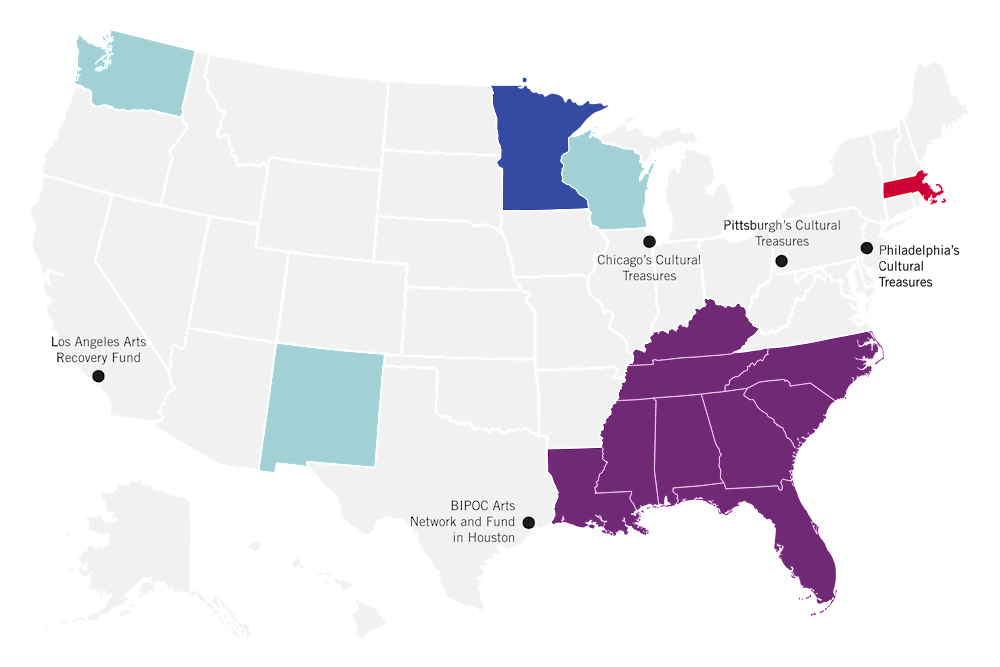
Ford’s regional initiative ultimately engaged more than 40 funders and philanthropies and distributed more than $276 million. Each of the nine participating regions were empowered to design their own approach, with local foundations driving decisions about scope, grantees, and structure.
SMU DataArts, in partnership with Ted Russell Consulting, was asked to evaluate how this initiative affected investment patterns in practice. Beyond investigating just what the money accomplished, we assessed what the process revealed about how philanthropy can work differently, and what funders can carry forward from this moment to the next.
The Starting Point
Before ACT funding began flowing in 2021, the data told a relatively consistent story. Across the five ACT cities where neighborhood-level comparisons were possible — Chicago, Houston, Pittsburgh, Philadelphia, and Los Angeles — arts organizations in BIPOC-majority neighborhoods were receiving less median foundation funding than those in white-majority neighborhoods in all but one of these cities. Median funding levels for organizations in BIPOC-majority zip codes fell short of white-majority zip codes by 24% in Chicago, 21% in Houston, 16% in Pittsburgh, and 5% in Philadelphia. Los Angeles was the exception with median funding levels 96% higher in BIPOC-majority zip codes compared to white-majority.
These discrepancies weren’t just a reflection of organizational budgets. They reflected decades of accumulated funding decisions that had systemically underinvested in BIPOC neighborhoods — leaving residents with fewer arts resources per capita than city averages. ACT was a direct attempt to interrupt that pattern and recognize organizations that have made a significant impact on the American cultural landscape despite these resource limitations. The nine-region initiative included both city-based programs and broader geographic areas, but it’s in these five cities where consistent, comparable data makes it possible to clearly measure change.
Intentional Investment
In every region, the share of ACT grantees in BIPOC-majority zip codes exceeded the local baseline. In other words, the funding didn’t just reach these communities, it was concentrated there deliberately.
That concentration produced measurable shifts in neighborhood-level funding patterns — and in some cases, dramatic ones. Chicago moved from 24% below white-majority zip codes to 60% above. Pittsburgh’s reversal was the starkest of all, moving from 16% below to 289% above. In four of five cities, ACT funds also went to zip codes with fewer arts resources than the city average. Equitable funding practices and broad cultural access turned out to be reinforcing goals, not competing ones.
Median arts funding to organizations in BIPOC-majority zip codes
compared to white-majority zip codes from 2019 to 2022
| Chicago: 24% lower → 60% higher |
| Pittsburgh: 16% lower → 289% higher |
| Philadelphia: 5% lower → 17% higher |
| Los Angeles: 96% higher → 3% higher |
By 2023, ACT grantees' organizational expenses had grown by an average of 34% compared to 2019. This growth represents real organizational capacity that didn’t exist before, and several regions saw even more dramatic growth. Grantees of First Americans’ Cultural Treasure with First Nations saw a change of 119% in expenses, BIPOC Arts Network and Fund in Houston grantees saw a change of 117%, and Southern Cultural Treasures with South Arts saw a change of 113%.
ACT’s impact during the grant term was real, but the investments made were temporary. Looking beyond the grant period, citywide funding patterns in the five comparable cities did shift modestly. Between 2019 and 2024 the proportion of total foundation dollars reaching BIPOC-majority neighborhoods increased slightly in four of the five regions but still fell short of parity. Widen the lens further to the national level, and the picture shifts again.
The National Snap-Back
In 2021, BIPOC-focused arts organizations saw a significant spike in revenue as funders across the sector responded to the urgency of that moment. By 2022, those patterns had reverted almost entirely to pre-pandemic trajectories. BIPOC-focused and general-mission organizations are now losing revenue at nearly the same pace, suggesting the exceptional conditions that drove relative gains have largely passed.
The uncomfortable truth that our research surfaces is this: the conditions that catalyzed rapid change toward more equitable funding practices were largely crisis-conditions. Urgency and public pressure to act loosened institutional norms but when those conditions faded, so did much of the momentum.
In contrast, funders who participated in the ACT initiative report lasting change in how they work. Stronger cross-funder relationships, broader familiarity with previously overlooked organizations, new tools for crisis response, and deeper experience with trust-based philanthropy were among the documented impacts.
The regional variation in ACT also matters here. Nine regions, nine different approaches from single-funder to full community-led structures produced different kinds of insights. That variation is a feature. It means many funders can find a model that fits their context rather than trying to replicate a single playbook.
Conclusion: The Reference Point
The current arts funding landscape looks nothing like 2020. Shifting federal priorities, institutional pullback from equity-centered commitments, and financial pressures have manifested in new ways. What was once framed as progress has in many places been recast as partisanship — and for some funders, funding decisions have followed that reframing.
And yet.
The organizations ACT recognized didn’t begin because a foundation noticed them. They existed before this funding arrived, built on community devotion and cultural necessity — and in many cases had long fought for philanthropic support that was slow to come, or came from different sources than those now investing in them.
The data tells us that intentional investment is achievable, particularly when urgency and pressure mount. But the organizations themselves tell us something the research can’t fully capture: that culture doesn’t wait for philanthropy to catch up. It continues in rehearsal spaces and community centers and studios, in the quiet, daily act of making something meaningful for the communities that show up for them. That persistence is, in its own way, proof of what ACT set out to recognize.
The question this research leaves us with is about intentional investment, but it’s also about how this work has changed the way funders see — and whether, when the urgency fades and the pressure lifts, that change in perspective holds.
An Evaluation of America's Cultural Treasures Initiative
Research conducted by SMU DataArts tracks progress in addressing historic disinvestment and surfaces lasting impacts on grantmaking practices.