- Sector Scan
Using Comparative Data to Fuel Cultural Development and Advocacy in Niagara County
- Posted Apr 28, 2026
6-minute read
SMU DataArts is delighted to feature a special article by Stacey McMath, a senior consultant at Webb Mgmt and professor at Bard College and at the Columbia University School of the Arts, who shares her expert insights on using data for cultural development and advocacy efforts.
The Cultural Alliance of Niagara (CAN) is a volunteer-run membership organization comprised of nine cultural institutions in Niagara County, New York. In 2024, the Buffalo-based Fund for the Arts, a funders’ cooperative of private, family, and corporate foundations, made a grant to assess the needs of Niagara County arts and cultural organizations and to develop a capacity-building plan for CAN.
This funding gave CAN the opportunity to pursue answers to questions asked by communities across the nation: What are the biggest challenges for local cultural organizations? How should we be investing in culture? How can we advocate for additional resources? Consultants from Webb Mgmt guided the process, providing research and planning support to help CAN document local arts organizations’ needs—and to make a plan to meet those needs.
CAN and the consulting team issued a county-wide survey of the cultural sector, compiled a cultural asset database, analyzed revenue sources and audience participation for CAN’s nine member organizations, interviewed stakeholders, and used available data sets to compare Niagara County with its neighboring counties in western New York. In interviews and focus groups, a consistent narrative emerged: the cultural community in Niagara County felt that neighboring Erie County had more investment, more cultural organizations, and more opportunities than Niagara County. Next, we looked to data to deepen our understanding of what was driving these local experiences.
Why Compare One Community with Another?
There is tremendous value in being able to compare data about the arts in communities. Many nonprofit organizations and municipalities operate in silos, and planning projects serve as an opportunity to learn from their peers. Fundamentally, people like comparison: how are we doing? Where do we excel? Where can we do better, and what communities can we look to for inspiration?
Cultural researchers can rely on geographically specific comparative data from a variety of sources: the census, American Time Use Survey, and the NEA’s Survey of Public Participation in the Arts. The MRI-Simmons Survey of the American Consumer is a national dataset that assesses the potential of a community to engage in specific types of arts activity and indexes it against the average American. For example, if a community is looking to build a new performing arts center, it might give cultural leaders confidence to know that members of the community are 50% more likely than the average American to attend a classical music, theater, or dance performance—particularly if other research reveals a lack of performing arts venues.
For the last decade, SMU DataArts’ Arts Vibrancy Index (AVI) has provided a simple, reliable measure for local and regional comparison. Cities and counties immediately grasp the concept: measures adjusted for population and cost of living can open stakeholders’ eyes to how culturally vibrant communities truly are, even if they are less populous or more rural.
Comparing Niagara and Erie Counties
Niagara and Erie counties are similar on a number of arts-related measures: 2024 per-capita spending on tickets to theater, opera, concerts, parks, and museums was similar. Each county saw about 3% of its population making a contribution to an arts or cultural organization in the previous year. Attendance for the performing and visual arts tracked almost identically across the two counties, with the difference in participation averaging less than a percentage point. This analysis conflicted with the assumptions shared by the community. Arts leaders and researchers were surprised by similar measures of arts participation given that Erie County has a higher population, density, educational attainment, and household income, all measures that often correlate with the strength of the arts sector.
Source: MRI-Simmons. (2025). Survey of the American Consumer [dataset]. Retrieved from Esri.
Diving Deeper with AVI
CAN was surprised and encouraged by Niagara and Erie Counties’ overall AVI measures. Niagara County claimed a stronger measure of arts providers than 89% of counties nationwide and a cost-of-living adjusted arts dollars index higher than 91% of counties nationwide. They were not surprised to see that Erie County scored slightly higher on these measures—but took it as good news given the flow of arts providers, audiences, and resources between the two counties.
| Market | Niagara County, NY | Erie County, NY |
|---|---|---|
| Arts Providers Index | 89 | 96 |
| Arts Dollars Index | 91 | 94 |
| Public Support Index | 76 | 92 |
The year after CAN’s assessment, DataArts released the 13 key indices that comprise the overall AVI. This provided the opportunity to further compare the two counties’ AVI scores. Erie County scored higher on several measures that feed into arts support and arts dollars, namely state arts funding, total government support, and program revenue, where there was an 18-point difference. Given the investment in Erie County’s sector, it is no surprise that these measures correlate to a higher score on arts and culture employees.
Niagara County’s score on arts and culture nonprofits was the notable outlier—nearly 14 points higher than Erie County’s despite having lower scores on nearly every other measure. This aligned with the findings of CAN’s cultural asset inventory, which identified more than 230 nonprofit and municipal arts and culture program providers across the county. This comparison also validated the findings of CAN’s county-wide survey, where respondents—arts and culture workers, leaders, and volunteers as well as artists and arts educators—identified challenges securing contributed income for a relatively high number of organizations and programs.
| Challenge | Percentage |
|---|---|
| Securing grants, donations, and sponsorships to pursue artistic and cultural projects. | 38% |
| Earning a living wage or compensating staff and/or collaborators with a living wage. | 27% |
| Convincing members of our community of the value of arts and culture. | 11% |
| Securing earned income, such as ticket sales, commissions, or artwork sales, to support projects. | 10% |
| Securing affordable space to pursue artistic and cultural projects. | 8% |
| Adequately promoting artistic and cultural projects, connecting with audiences. | 4% |
| Including diverse voices in organizational leadership and/or reaching audiences in marginalized communities. | 2% |
Source: Cultural Alliance of Niagara. (March 2025). Niagara County Arts Survey [dataset].
Using Comparative Data for Advocacy
In the coming years, CAN plans to expand from an all-volunteer organization to one with professional staff and a slate of professional development and advocacy programs that will provide support for Niagara County’s cultural organizations. An early focus of CAN’s advocacy work is expected to be county and local government, where CAN will use highlight Niagara County’s impressive number and diverse array of arts providers, as well as the comparatively lower scores on revenue, compensation, and government support, to galvanize local investment in arts and culture. The findings of this research effort gave CAN’s leaders the data they needed to reframe as an advocacy organization—serving not just the nine original members, but the rich tapestry of organizations that this project documented.

Stacey Cooper McMath is a Senior Consultant at Webb Mgmt, where she focuses on strategic planning, sector assessment, and advisory services for local arts agencies. Prior to joining Webb Mgmt Stacey served for eight years as Director of the Programs Unit in the New York City Department of Cultural Affairs. In 2020 she was named a Women in Power Leadership Fellow by the Belfer Center for Innovation at the 92nd Street Y.
Stacey teaches at Bard College and at the Columbia University School of the Arts.
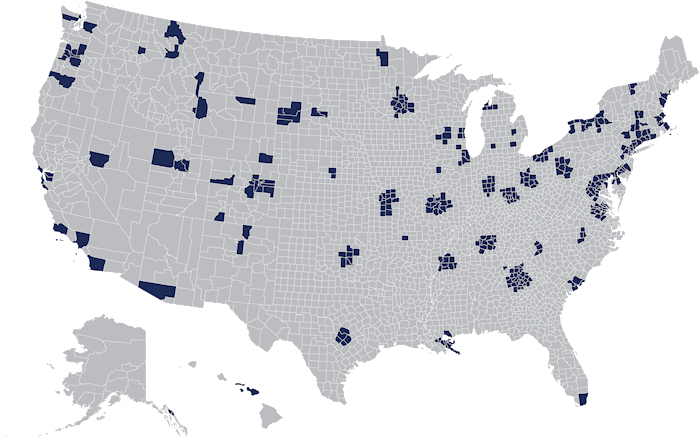
The Most Arts-Vibrant Communities of 2025: County and State Rankings
Jackson, WY-ID, claims the title of #1 most arts-vibrant community in the nation, with particular strengths in federal arts grants and funding. Meanwhile, New York leads as the top-ranked state and boasts 9 communities in the top 100—more than any other state.