Our Methodology
We assess the vibrancy of communities and states around the country by leveraging key statistics about arts and culture that are available for all communities. This methodology details the measures and calculations for arts vibrancy. For answers to commonly asked reader questions about the Arts Vibrancy Index, please visit our FAQ page.
How is Arts Vibrancy Calculated?
Arts and cultural organizations are deeply embedded in their communities. In calculating arts vibrancy, SMU DataArts combines data from nonprofit arts and cultural organizations with data for the communities in which they reside. By geolocating organizations and linking them to their community’s characteristics in the data, we can identify factors that affect the health and sustainability of arts organizations. The ecosystem-level variables included in this report are important influences on a variety of financial, operating, and attendance outcomes for arts and cultural organizations.
When assessing an area’s vibrancy, we take a data-driven approach, drawing on 13 measures which cover aspects of supply, demand, and public support for arts and culture, and adjust for cost of living and for population size.
- Arts Provider metrics are a gauge of supply and include the number of independent artists, arts and culture employees, nonprofit arts and cultural organizations, and arts, culture, and entertainment firms in the community.
- Arts Dollar metrics represent a gauge of demand for nonprofit arts and cultural programming, including earned revenue from program activities, contributed revenue supporting the arts, total compensation to artists and staff, and total expenses.
- Government Support is a gauge of public support for arts and culture, captured as the number and dollar amount of state and federal grants and total government grant dollars in the community.
Table 1 below includes additional details on what we measure and the sources of data for each metric. We adjust revenue and expense figures by a cost-of-living index. We use the Cost of Living Index published by the Council for Community and Economic Research (C2ER).
The arts vibrancy rankings are constructed through a factor analysis model that incorporates all 13 inputs. The model estimates factor loadings, which represent the strength and direction of each variable’s association with arts vibrancy and serve as their weights in calculating the composite measure.
For context, prior to the 2023 index, we generated three separate factors (arts providers, arts dollars, and government support) and applied an a priori weighting scheme (45%, 45%, 10% - respectively) to each of those factors to create rankings. Starting in 2023, all 13 inputs were weighted through the empirical approach described above where the strength of the relationship between each item and the underlying factor determines the weights. Compared with the earlier method, this data-driven approach does not impose a pre-determined structure of the underlining relationships among the three factors; however, it increases sensitivity to shifts in data availability from year to year, which may affect measurement consistency.
TABLE 4: Index Components (per capita measures)
| METRIC | MEASURES | DESCRIPTION |
| Arts Providers | County and ZIP code Business Pattern data collected and disseminated by the US Census Bureau. Arts and cultural organization data aggregated from IRS 990s. | |
| Independent artists | Freelance artists primarily engaged in performing in artistic productions, in creating artistic and cultural works or productions, or in providing the technical expertise necessary for these productions, aggregated at the zip code level | |
| Arts and culture employees | Number of people employed by the museum, historical site, theater, dance, music, opera, and other performing arts sectors, as salaried employees or independent contractors, aggregated at the county level | |
| Arts and cultural organizations | Number of nonprofit organizations in the museum, arts education, community, dance, music, opera, performing arts center, orchestra, theater, multidisciplinary performing arts, or arts alliance and service organization sectors, aggregated at the zip code level | |
| Arts, culture & entertainment firms | Number of arts, culture, and entertainment firms, weighted for size and aggregated at the zip code level. Includes museums, theaters, dance companies, opera companies, music groups and performers, music producers and presenters, fine arts schools, and recording, motion picture, and video production companies | |
| Arts Dollars | Data aggregated from IRS 990s, SMU DataArts' Cultural Data Profile, and Theatre Communications Group | |
| Program revenue | All revenue earned due to people participating in the activities of nonprofit arts and cultural organizations* | |
| Contributed revenue | All revenue from contributions to nonprofit arts and cultural organizations (includes public funding)* | |
| Total expenses | All expenses of nonprofit arts and cultural organizations* | |
| Total compensation | All payment to staff and artists by nonprofit cultural organizations* | |
| Government Support | Data collected and disseminated by the National Endowment for the Arts, Institute of Museum and Library Services, and National Assembly of State Arts Agencies | |
| State arts dollars | All state arts dollar funding in the community* | |
| State arts grants | Number of state arts grants awarded in the community | |
| Federal arts dollars | All NEA and IMLS dollar funding in the community* | |
| Federal arts grants | Number of NEA and IMLS grants awarded in the community | |
| Total government support | All government dollar funding in the community (federal, state, and local) | |
*Adjusted by a cost-of-living index
For our community rankings, there are 949 unique MSAs and Metro Divisions, any ranking in the top 100 puts that community roughly in the top 10% nationally.
Key Definitions
Communities are delineated by the Office of Management and Budget (OMB) as CBSAs, or Core Based Statistical Areas (CBSAs). The Census Bureau and other government agencies use CBSAs when collecting, organizing, and analyzing data. Focusing on CBSAs provides a nationally standardized, objective approach to delineating markets. CBSAs are frequently centered on one large city or twin cities, but they capture the network of suburbs that rise up around a city or town rather than considering them separately. A key feature, is the “high degree of integration with the nucleus.”
Visitors, audiences, artists, and arts workers often live in nearby suburbs, production and storage facilities are frequently located in lower-cost areas outside the city’s boundary, and major airports that serve local arts and cultural organizations are commonly located beyond city boundaries. For these reasons, OMB’s CBSA framework more accurately reflects the functional geography of arts and cultural ecosystems.
Where the OMB breaks down very large CBSAs with populations over 2.5 million into Metropolitan Divisions, we do the same. Metropolitan Divisions function as distinct social, economic, and cultural areas within the larger CBSA [Accessed 1 Dec 2022]. In total, there are 947 unique Metro Divisions and CBSAs in the U.S.
In July 2023, the Office of Management and Budget released revised delineations for the nation's CBSAs, based on 2020 census data. These changes are reflected in the 2025 edition of the index. In many cases, the community boundaries used to compile arts vibrancy measures have changed, which can have material affects on the rankings themselves due to differences in arts vibrancy measures as well as population and cost of living in the adjusted geographical area. Crosswalks detailing which counties are included in the various CBSAs included in the index are available here from the National Bureau of Economic Research.
We have added size categories within our list to provide context about the size of each community. These are defined as:
- Large CBSAs (and Metro Divisions) with populations over 1,000,000
- Medium CBSAs with populations of 100,000 to 1 million
- Small CBSAs with populations under 100,000
To identify arts and culture nonprofits we aggregate measures across the 13 arts and culture sectors that are included in SMU DataArts’ research: Arts Alliances and Service Organizations, Arts Education, Art Museum, Community, Dance, Music, Opera, Performing Arts Center, Symphony Orchestra, Theater, Other Museum, and Multidisciplinary Performing Arts.
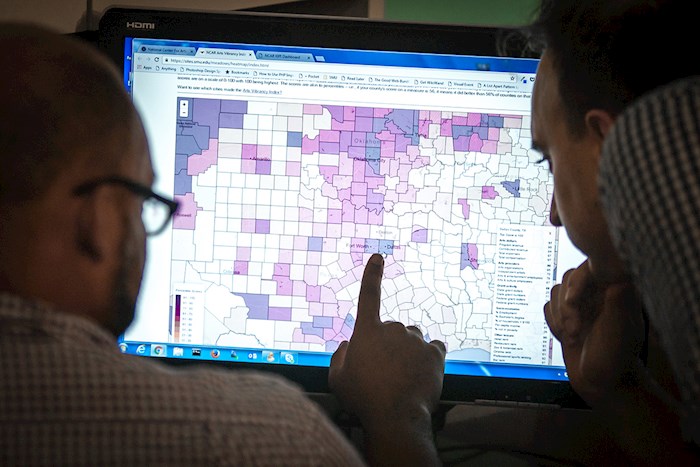
Dive into the Data
Get more details about the rankings and visualize state and community data in depth.