Arts Vibrancy Index 2025: 10 Years of Data-Driven Analysis
Published January 8, 2026
Executive Summary
Ten years ago, researchers at Southern Methodist University’s (SMU) National Center for Arts Research confronted a measurement gap. While data on individual arts organizations—their financial performance, attendance patterns, operational structures—offered one lens into the cultural sector, it reveals little about the broader ecosystem in which these organizations operated. What community-level factors influenced organizational success? How could researchers account for conditions beyond an organization’s walls?
The Arts Vibrancy Index was developed to address this by measuring supply, demand, and public support for arts and culture at the community level, with adjustments for population and cost of living. This approach offered a new framework for understanding where cultural ecosystems thrive.
This year marks a decade of measurement. In celebration, we’re releasing our most comprehensive analysis yet: rankings for the top 100 communities nationwide and all 50 states. This milestone offers an opportunity to reflect on current patterns in arts vibrancy and the evolution of the index as a research tool, it’s expanded scope, and it’s impact on communities and funders across the country.
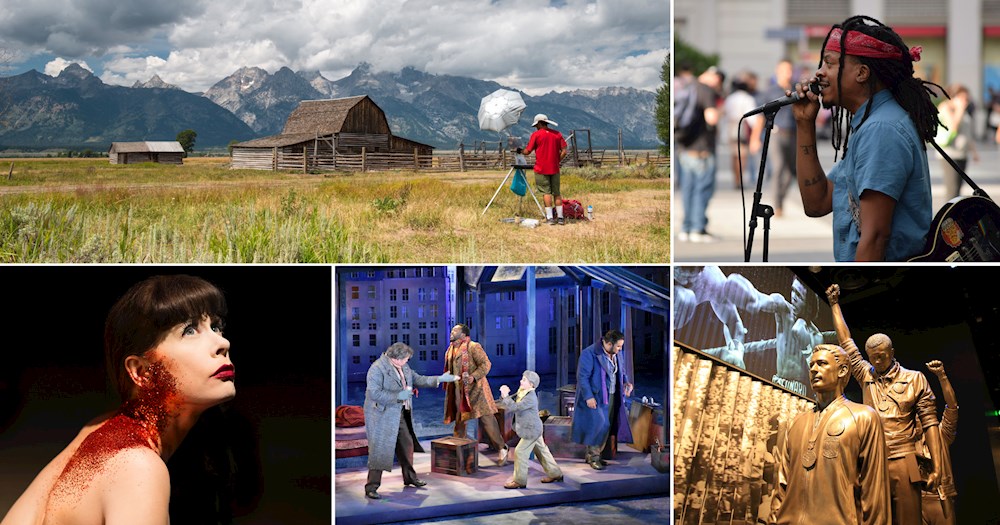
Photos from Jackson, WY; New York, NY; San Francisco, CA; Santa Fe, NM; and Washington, DC
In 2012, Dr. Zannie Giraud Voss and her colleagues Glenn Voss and Rick Briesch were launching SMU’s National Center for Arts Research, during a time when the arts policy landscape was shifting. Funders and policymakers increasingly recognized the role of arts and culture in community development and quality of life. ArtPlace America, two years into its ambitious decade-long initiative, was gearing up to channel unprecedented funding into arts-driven community projects. The National Endowment for the Arts’ (NEA) Our Town program had just announced grants supporting creative projects in communities large and small. Local arts agencies were gaining recognition for their roles in building vibrant cultural ecosystems.
Despite this momentum, there was no comprehensive method to compare communities or understand what made one place more culturally vibrant than another.
“We wanted to understand better not only how arts and cultural organizations performed along a variety of measures but also what was happening in the community beyond the organization’s control that might help explain its finances, attendance, and operations,” Zannie recalls. The team gathered data, geocoded it, and analyzed each community alongside how organizations within it performed.
The results fascinated them. But then came another question: If you’re a community leader reading a report about characteristics that drive strong arts organizations, how would you know where your community stood?
They created an online map allowing people to click and see for themselves. “In the process, it quickly became apparent to us which communities exhibited strengths in multiple ways,” Zannie says. “Why not share that with the field, too? Hence, the idea for the Arts Vibrancy Index Report was hatched.”
Building Something That Lasts
From the start, the Arts Vibrancy Index rested on three principles that have remained constant through every iteration.
First, we measure the arts as an end unto themselves—not as a tool for economic development or tourism, but as fundamental to community life. The index tracks three areas: arts providers, arts dollars, and government support. We focus on measures available for every community in the U.S., minimizing bias based on local data collection capacity and ensuring apples-to-apples comparisons.
Second, we use a per capita approach. This ensures that cultural vitality is not dictated by population size, but by genuine investment in and commitment to the arts, given the size of a community. For instance, a small mountain town like Jackson, Wyoming with its robust cultural infrastructure can rank alongside—or even above—major metropolitan areas.
Third, we adjust for cost of living. A dollar spent on arts in rural Montana stretches further than a dollar in Manhattan. Our methodology accounts for these economic realities, ensuring that communities aren’t penalized—or artificially boosted—simply by geography.
These methodological principles were radical in their results: demonstrating that vibrant arts ecosystems can exist anywhere, given the right support and commitment. Read more about our methodology.
While the data tells one story, the feedback from arts leaders, practitioners, and supporters over the years adds another dimension of impact.
When Bennington, Vermont first appeared in the rankings, local arts leaders wrote in to express how meaningful the recognition was for their town of 15,000. National validation provided ammunition for advocacy, pride for fundraising, and proof that their efforts were making measurable impact.
Jackson, Wyoming has also leveraged its high-ranking year after year. Abbot Gilbane from Center for the Arts put it simply, “Nonprofit arts organizations in Jackson rely on consistent support of donors in our community. We can’t support our programs and facility maintenance needs through ticket and art sales alone. It is so valuable for us to show our donors and patrons that our efforts to serve the arts by connecting our creative community are recognized nationally though the Arts Vibrancy Rankings.”
Beyond the numbers, the index provides communities with language, evidence, national context for local conversations, and can spark strategic action toward real solutions.
In 2023, our research revealed positive relationships between Local Arts Agency (LAA) funding and virtually every component of arts vibrancy in a community—more arts employees, more independent artists, more nonprofit arts organizations per capita, more arts firms. These numbers were backed with more than 70 testimonials from LAA leaders and community members, creating a powerful evidence base for the value these agencies provide.
AVI data has not only informed conversations about enhancing arts vibrancy within regions but has also given life to real solutions. When the Houston Endowment, for example, discovered Houston had fewer independent artists than peer cities, they didn't just note the gap—they funded a project to understand why and what could change this dynamic. SMU DataArts and FreshArts are now working together to better understand the needs of Houston's independent artists.
Over the past ten years, the Arts Vibrancy Index has continually evolved to meet the changing needs of communities and address emerging questions about cultural vitality.
Two major advancements were made in recent years. First, we introduced communications toolkits—ready-to-use resources to help communities turn national recognition into local impact. Arts leaders could now share the news with city councils, donors, and local media, poised with graphics and key talking points to build empowering, data-driven narratives.
Second, we launched our first state-level analysis and rankings, released in March 2024. This new view revealed how access to arts providers, demand for the arts, and funding play out on a state level. In our initial release we explored how vibrancy scores intersected with poverty rates and rural/urban populations. States with higher poverty rates and more rural populations tended to score lower on arts vibrancy, but with notable exceptions: Minnesota, Vermont, and Maine have high percentage of rural regions but highly ranked in overall arts vibrancy; and New York with its exceptionally high ranking in overall arts vibrancy but also with a relatively high poverty level. These patterns have persisted through two subsequent editions of the state rankings.
In 2024, we identified the nation’s top 30 rural counties, partnering with Geoffrey Kushner from Small Town Big Arts to map insights from arts leaders in these areas onto a set of models for how organizations can foster arts vibrancy in small communities. The project challenged assumptions about where arts ecosystems thrive and highlighted patterns of success in places often overlooked by national conversations.
Celebrating a Decade of Arts Vibrancy Rankings
This year, we’re releasing the third edition of state rankings and we’ve expanded the community rankings to 100—up from 40 in previous years. The differences in scores between communities ranked 40th and 60th are often minimal, and the lived experiences of arts vibrancy in these places doesn’t differ dramatically. By expanding the list, we can celebrate more communities, give more arts leaders tools for advocacy, and paint a more complete picture of where cultural vitality is strongest across the nation.
We’ve also unified the list. Our per capita methodology already ensures small and mid-sized communities are evaluated consistently, so removing size categories simplifies the list and allows readers to explore and sort the complete rankings in our data explorer.
Ten years in, the 2025 rankings reveal a nation where arts vibrancy exists everywhere—but in patterns worth examining.
As you might expect, New York leads as the nation’s cultural powerhouse for the third consecutive year along with boasting nine communities in the top 100. This year, Connecticut jumped to #3 in the state rankings, the largest advancement of any state.
We're also celebrating two special cohorts for 2025. Seventeen communities that have appeared on every list since 2015 earn the title as a "10-Year Veteran"—demonstrating sustained excellence across a full decade of economic ups and downs. Additionally, twenty-two communities that have appeared at least three times since 2020 have been named as "Frequent Mentions," signaling sustained cultural vitality in places like Ithaca, New York, Bozeman, Montana, and Austin, Texas.
A decade of analyzing data has confirmed that arts vibrancy isn't accidental. It's built through long-term commitment to funding for arts organizations, support for individual artists, public investment in cultural infrastructure, and valuing creativity as essential to quality of life.
These rankings celebrate where that commitment exists. They also reveal where gaps remain. Both are crucial in the ongoing effort to create and sustain thriving communities. To the artists, arts organizations, funders, policymakers, and community members who make vibrant arts ecosystems possible, this index exists because of your work. View the archive.
Top 100 Most Arts-Vibrant Communities of 2025
This year marks the tenth edition of SMU DataArts’ Arts Vibrancy Index with a unified and expanded list that reflects the reality that vibrant arts and culture can flourish anywhere across the nation—from small mountain towns to major metropolitan areas.
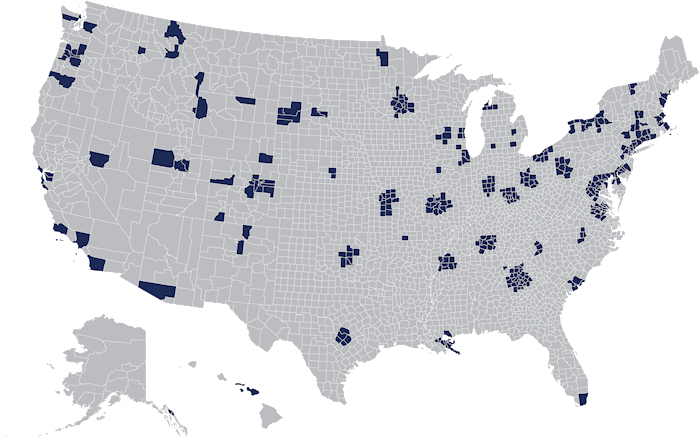
Arts Vibrancy Rankings for All 50 States
While the 2025 rankings show overall stability—with New York maintaining its #1 position for the third year running—Connecticut's rise to #3 in the rankings demonstrates how dynamic a state's creative ecosystem can be. See how states compare on measures of arts supply, demand, and public support for the arts. Explore the List